Why Electric Motors Overheat — and How to Catch It Before Burnout
Heat is the quiet killer of electric motors. A bearing defect announces itself with vibration, a misalignment shows up in the spectrum — but thermal degradation works invisibly, inside the winding insulation, until the motor trips or burns out mid-shift.
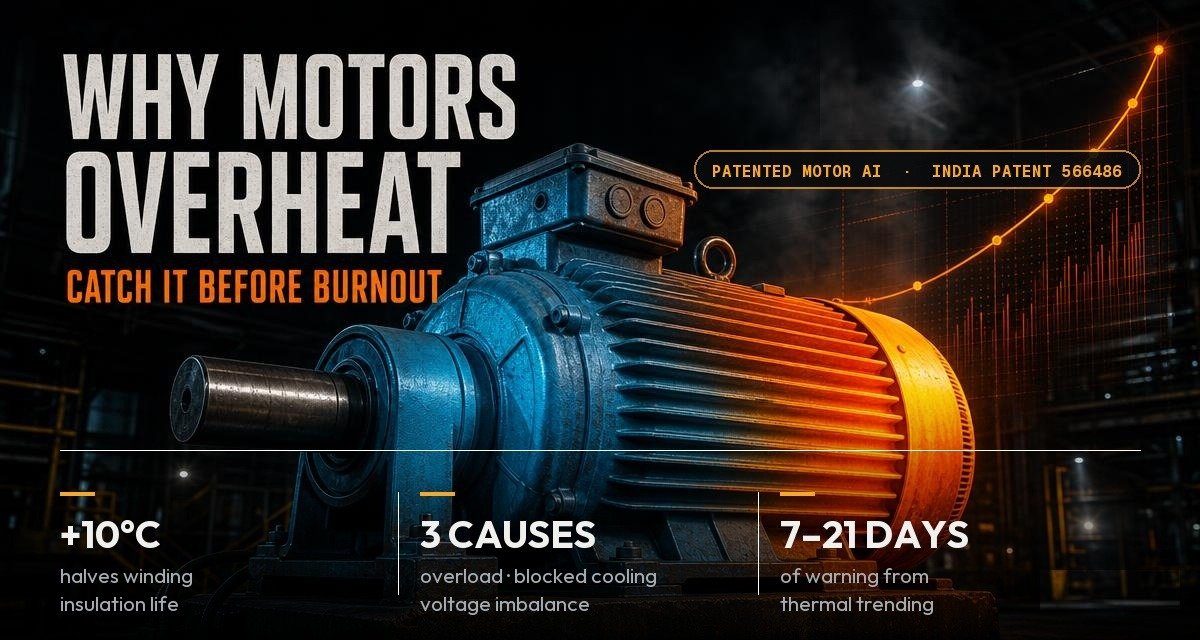
The rule of thumb reliability engineers use is simple and unforgiving: for every 10 °C of sustained operation above the insulation class rating, expected insulation life is roughly halved. A motor running 20 °C hot is not "a bit warm" — it is quietly consuming three-quarters of its remaining service life.
What Actually Makes a Motor Overheat
1. Sustained overload The most common cause. Process changes, worn driven equipment, a clogged impeller, or a conveyor running heavier material all push current above nameplate. The motor draws more, copper losses rise with the square of current, and winding temperature climbs.
2. Blocked or degraded cooling Dust caking on the frame fins, a damaged cooling fan, blocked ventilation ducts, or a motor installed too close to a wall. In cement, steel, and textile environments this is routine — and it happens gradually, so nobody notices until the trip.
3. Voltage imbalance and supply quality A phase imbalance of just 3–4 % can raise winding temperature dramatically, because negative-sequence current heats the rotor disproportionately. Loose terminals, ageing contactors, and unbalanced single-phase loads on the same feeder are typical sources.
4. Excessive starts and duty-cycle abuse Every start pulls locked-rotor current — often 6–8× full load. Motors driving high-inertia loads that are cycled frequently never get the chance to shed the heat from the previous start.
5. Bearing friction and mechanical drag Failing bearings, over-greasing, misalignment, and belt over-tensioning all convert mechanical energy into heat at the bearing housing. Bearing temperature usually leads winding temperature in these cases.
6. Ambient and enclosure conditions Motors near furnaces, dryers, or in enclosed pump houses operate on a permanently elevated baseline. A design that was fine in winter fails in peak summer.
The Failure Curve: Why Temperature Gives You Time
Thermal failures are progressive, and that is the opportunity. In practice the sequence looks like this:
- Weeks out — average operating temperature drifts 3–8 °C above the machine's own historical baseline for the same load. Nothing alarms; the motor is still well inside its trip limit. - Days out — the cool-down profile changes. The motor takes noticeably longer to return to baseline after a load peak, indicating cooling capacity has degraded. - Hours out — temperature rise rate accelerates, often alongside a rising vibration floor as bearing clearances change with expansion. - Failure — insulation breakdown, phase-to-phase short, or a thermal trip that becomes a rewind.
Almost every plant has a thermal trip. Almost no plant has a system watching the *trend* between normal and trip — which is exactly where the warning lives.
Why Periodic Thermography Misses It
Handheld thermal-imaging rounds are valuable, but they are snapshots. A monthly route gives you twelve data points a year, always taken at whatever load happened to be running that morning. Thermal degradation is a load-dependent trend, and you cannot see a trend from a snapshot. The failures that hurt are the ones that develop entirely between two inspection rounds.
What Continuous Monitoring Changes
KLVIN's approach is to treat each motor as its own reference. THRIVE sensors capture surface and bearing-housing temperature continuously, while S.A.M v3 captures the vibration and acoustic signature from the same asset. The SENTINEL platform correlates them and learns what "normal" looks like *for that motor at that load* — not against a generic table.
That makes three things possible:
1. Baseline-relative alerting. A 6 °C drift above the motor's own load-normalised baseline raises a flag long before any absolute threshold is crossed. 2. Cause separation. Rising bearing-housing temperature with a matching vibration signature points to mechanical drag. Rising winding-side temperature with a stable vibration floor points to electrical loading or cooling loss. The maintenance action is completely different, and knowing which one you have saves a wasted intervention. 3. Cool-down profiling. Degrading cooling shows up in the recovery curve well before it shows up in the peak — a signal that is essentially impossible to catch manually.
A Practical Checklist for Plant Teams
- Record the ambient-corrected baseline temperature for every critical motor at typical load, and treat deviation from *that* number as the alarm — not the nameplate limit. - Check phase voltage balance quarterly; anything above 2 % deserves investigation. - Clean cooling fins and verify fan condition on a fixed schedule in dusty processes. - Log start counts on high-inertia drives and compare against the manufacturer's permitted starts per hour. - Trend bearing-housing temperature alongside vibration — the pair is far more diagnostic than either alone. - Instrument the motors whose failure stops production, not the ones that are easiest to reach.
The Bottom Line
Motor burnout is rarely a sudden event. It is a slow thermal story with a visible beginning, and the plants that read that story early replace a bearing on a planned shutdown instead of rewinding a motor during an unplanned one.
KLVIN's patented full-stack motor AI monitors temperature, vibration, and acoustics continuously and flags developing thermal faults with typically 7–21 days of lead time. You can see how the motor health model works on our Motor Intelligence page, or run your own numbers in the ROI calculator.